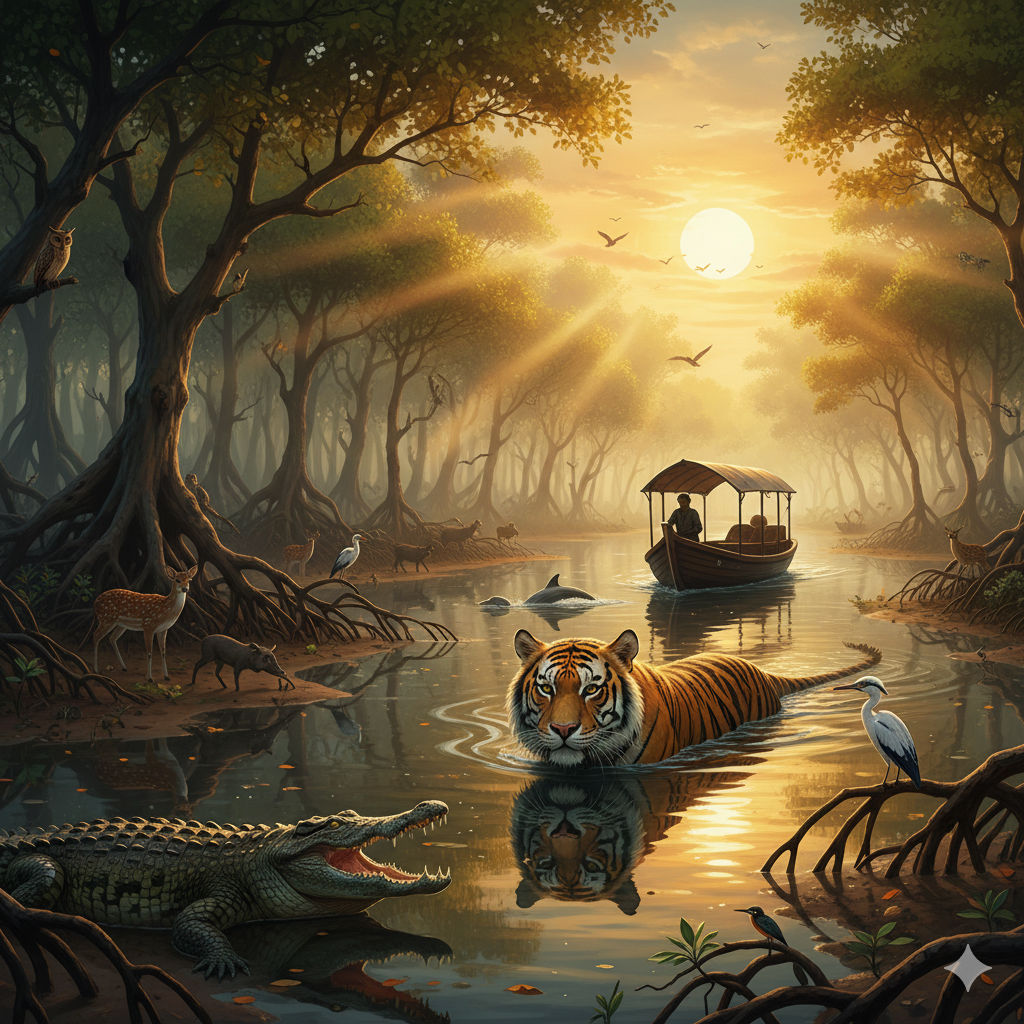
The Silent Sentinels: Discovering the Magic of the Sundarbans
There is a specific kind of silence that exists only in the Sundarbans. It isn't the absence of sound, but rather a dense, vibrating layer of life—the clicking of crabs, the distant call of a Buffy Fish Owl, and the rhythmic lap of brackish water against the pneumatophores (breathing roots) of the Sundari trees.
As the largest halophytic mangrove ecosystem in the world, the Sundarbans serves as a massive green shield for the coastlines of West Bengal and Bangladesh. It is a place where the tides dictate the tempo of life; twice a day, the forest floor vanishes under the rising sea, only to emerge again, glistening with silken mud.
The Lord of the Mangroves
While many visit with the hope of spotting the Royal Bengal Tiger, the true essence of the forest lies in its unpredictability. These tigers are unlike any others on earth; they are master swimmers, capable of crossing kilometers of open water. Because they live in such a challenging, salty environment, they have developed a legendary reputation for being more elusive and cunning than their inland cousins.
Watching the sun dip below the horizon from a boat in the middle of a narrow creek, you realize that the forest is not just a place to visit—it is a living, breathing entity that demands respect.
A Biodiversity Hotspot
Beyond the apex predator, the Sundarbans is a bustling metropolis of rare and endangered species:
Irrawaddy Dolphins: Often seen breaking the surface in the deeper channels.
The Masked Finfoot: An incredibly rare water bird that enthusiasts travel continents to glimpse.
Estuarine Crocodiles: Massive reptilian giants that represent a lineage millions of years old.
Why the Sundarbans Matters
The forest is more than a tourist destination; it is a global treasure. It acts as a carbon sink, absorbing vast amounts of greenhouse gases, and protects millions of people from the ferocity of tropical cyclones. To visit the Sundarbans is to witness a delicate balance between survival and serenity—a reminder of why we must protect our planet's most fragile wild places.